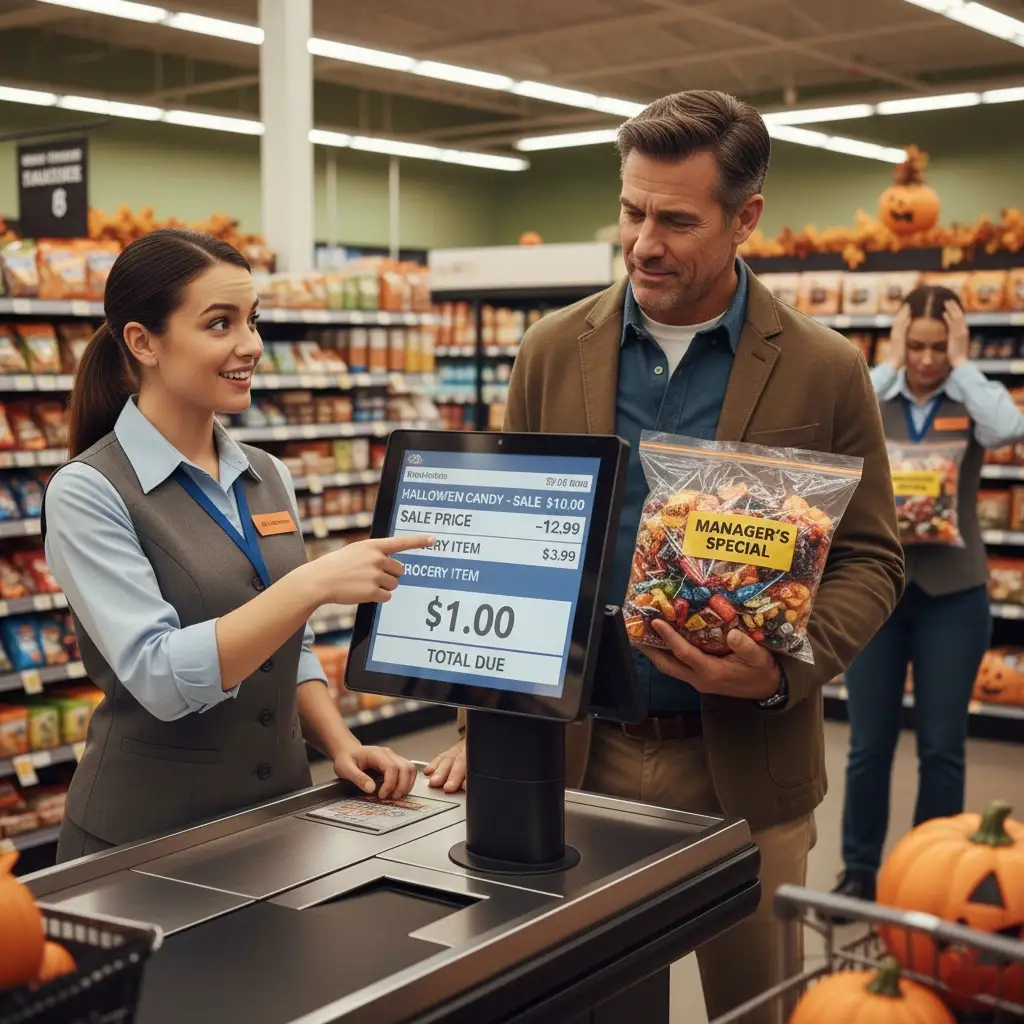
I work as a cashier and self-checkout attendant at a grocery store. Besides scanning items as a cashier and keeping an eye on people to make sure they don’t steal things as a self-checkout attendant, I also assist customers on the self-checkouts when they need it and fix errors that occur. Today, in the first week of November, I ran into an… interesting… problem.
I noticed that one of the self-checkouts had a customer who was seemingly perplexed about something with the large bag of Halloween candy that he had just scanned, so I walked over to see what he needed help with. The moment I looked at the screen, I realized something was very wrong: he had scanned two items, one of which was $3.99 (not the candy), and the total price before tax was… $1.00?
Looking at the candy price, I understood what had happened easily enough, though the fact that it happened at all was facepalm-worthy. You see, besides coupons, there are two types of discounts at my store. First, the [Store Discount Card] discount, which brings down the price from the “regular” price to the sales price (assuming the item is on sale). The other type is the “manager’s special” markdown, which takes the form of a yellow barcode sticker that lists the marked-down price in big print and the “was” price and “amount off” amounts in smaller print. The way the manager’s special markdown barcodes actually work is this: the barcode is scanned instead of the product’s original barcode, and the register scans it in at the normal price, then adds a negative value as a separate line item for the “amount off,” which brings the amount actually charged to the marked-down price.
What counts as the “normal” price? Well… if you’re not using a [Store Discount Card], that would be the non-sale price. But if you ARE using the discount card, that would be the sale price.
I’m sure the most astute readers have already realized where this is going.
The candy was Halloween candy in November, so it had a manager’s special markdown on it: it was $18.99, marked down to $6.00, for a discount of $12.99. (Post-holiday markdowns are crazy sometimes; this was fairly normal.) So, if all was well, the register should say $18.99 for the candy, then -$12.99 for the markdown.
But it didn’t. That was because the store had ALSO put a sales discount on the candy, which just lowers the “normal” price line to the sales amount. The candy was on sale (post-Halloween, remember) for $10.00. So the first line said the candy was $10.00, and the second line said the markdown was -$12.99.
That’s right: both discounts stacked, bringing the total price of the candy to -$2.99! When their second item, costing $3.99, was added, that made the total price for the entire order $1.00 (plus tax). It was easy enough to fix by going in and voiding it and entering the $6.00 it was supposed to be directly, but I was shaking my head and laughing that it had happened. Thankfully, the customer wasn’t upset about losing their negative cost candy purchase and just found it amusing.
But it doesn’t end there! I reported the incident to my supervisors, who told me to tell the person who puts those manager’s special stickers on. When I did, and told her she should check the other candy that was marked down just in case, she agreed that it was a good idea. There were only two bags left, and they both had the same issue, which she then had to figure out how to fix.
It was early afternoon, and the candy bags had been “sold” all day. I was the first employee to notice. I guess that’s what the store gets for refusing to pay people enough to proactively care about things.