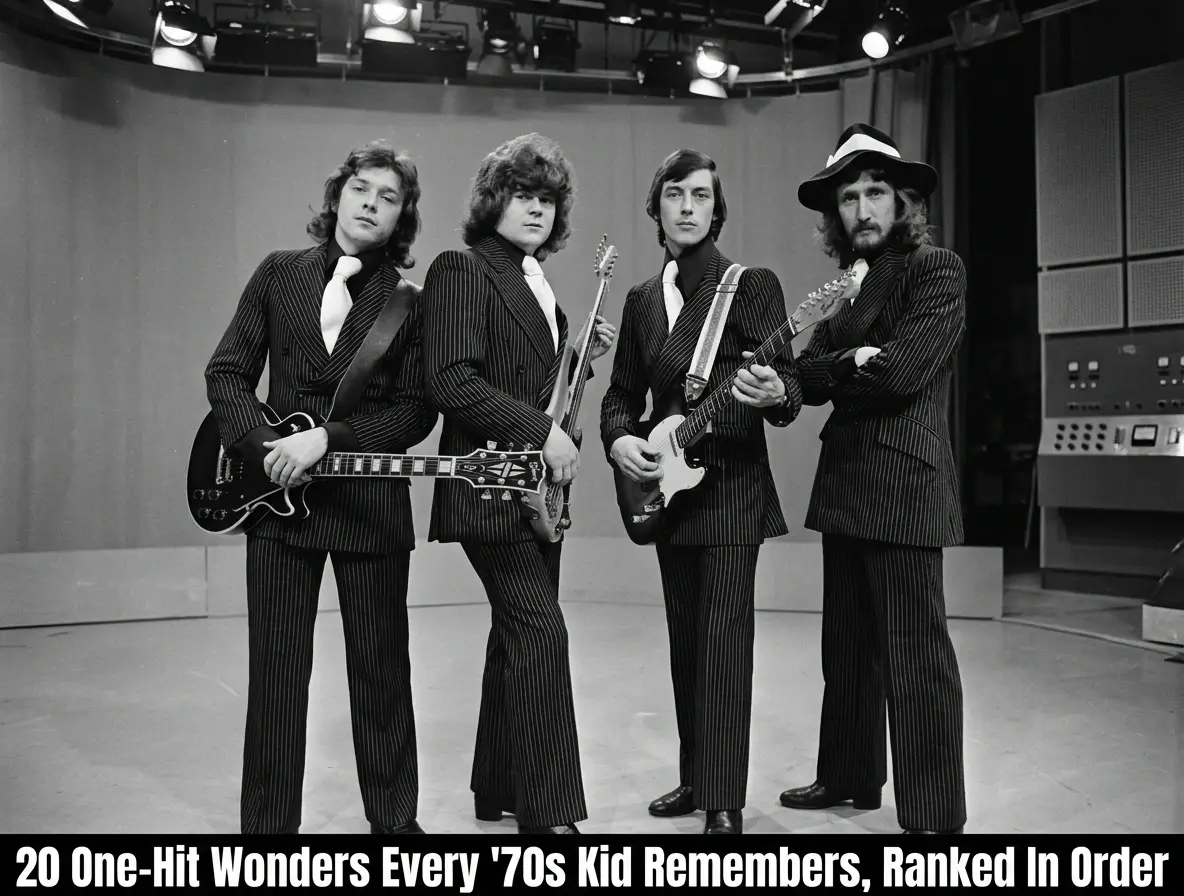
If you grew up with a radio playing somewhere in the house during the 1970s, you probably remember certain songs before you remember the names of the artists who sang them.
Some of these tracks were everywhere for a brief moment—on the radio, at parties, in cars, and on record players—only to become the kind of songs people later described as one-hit wonders.
But there’s something fascinating about these forgotten hits: decades later, a few seconds of the melody can still transport you straight back to the 1970s. So we’ve ranked 20 memorable examples from the decade, starting with the songs that made the biggest impression and ending with those that deserve a second listen.
And don’t be surprised if one of your old favorites shows up much higher—or lower—than you expected.
1. “Stuck in the Middle with You” — Stealers Wheel
Few songs from the 1970s have an opening quite as recognizable as this one.
Released by Scottish band Stealers Wheel in 1972, “Stuck in the Middle with You” had a quirky, almost playful sound that made it stand out from many of the decade’s more serious rock songs.
The song became a major U.S. hit, and its catchy chorus helped give it a life far beyond its original chart run. Even people who don’t immediately remember the band’s name often recognize the song within seconds.
That’s part of what makes it such a memorable one-hit-wonder candidate: the song became far more famous than the name behind it.
2. “Spirit in the Sky” — Norman Greenbaum
That unmistakable guitar riff makes this one almost impossible to confuse with anything else.
Norman Greenbaum’s “Spirit in the Sky” was released in 1969 but became a huge hit in 1970, making it one of those songs that feels completely at home in the early-’70s soundtrack.
Its unusual combination of a heavy guitar sound and spiritual lyrics helped it stand apart.
For many listeners, the song is remembered less as something they deliberately chose to play and more as something that seemed to be everywhere.
And sometimes that’s exactly what makes a song survive for generations.
3. “Brandy (You’re a Fine Girl)” — Looking Glass
If you remember the soft-rock side of the 1970s, there’s a good chance this song brings back memories immediately.
Looking Glass released “Brandy (You’re a Fine Girl)” in 1972, and the song quickly became one of those romantic radio favorites that seemed to fit perfectly into the decade.
The story about Brandy, the woman who falls for a sailor who ultimately chooses the sea, gave the song something many pop hits didn’t have at the time: a little story to follow.
Years later, people might forget the band’s name—but that chorus tends to stick.
4. “Afternoon Delight” — Starland Vocal Band
Few song titles are as instantly recognizable as “Afternoon Delight.”
Released in 1976, the song became a major hit for the Starland Vocal Band and earned a place in 1970s pop culture almost immediately.
Its cheerful, almost innocent-sounding harmonies contrasted with the more suggestive meaning of the lyrics, which helped make it especially memorable.
It is also a perfect example of why nostalgia lists like this work so well: you may not have heard the song in years, but the moment someone mentions the title, the melody can come rushing back.
5. “The Night Chicago Died” — Paper Lace
This wasn’t exactly a typical love song.
Paper Lace’s “The Night Chicago Died” turned a fictionalized story involving gangsters, police, and a dramatic shootout into a surprisingly catchy pop hit.
Released in 1974, the song became particularly memorable because it sounded almost like a miniature historical drama set to music.
Whether listeners took the story literally or simply enjoyed the theatrical presentation, the song certainly left an impression.
And decades later, that dramatic chorus is still enough to make many former ’70s kids say, “Oh, I remember this one!”
6. “Kung Fu Fighting” — Carl Douglas
You didn’t need to be a martial-arts fan to recognize this song.
Carl Douglas’s “Kung Fu Fighting” became an enormous international hit in 1974, riding the popularity of martial-arts movies and the fascination surrounding kung fu at the time.
The song’s instantly recognizable rhythm and repeated vocal hook made it incredibly easy to remember.
It was also wonderfully representative of its era. The 1970s had a habit of turning cultural trends into unexpected pop hits—and this was one of the most successful examples.
7. “The Streak” — Ray Stevens
Ray Stevens took a bizarre cultural phenomenon and turned it into a novelty hit.
“The Streak” became a major success in 1974, inspired by the streaking craze that had become a widely discussed phenomenon at the time.
Rather than treating the subject seriously, Stevens turned it into a comedic story song filled with spoken sections and memorable characters.
That’s why it still feels different from most songs on a 1970s playlist.
It wasn’t trying to be timeless.
It captured a very specific moment—and somehow became timeless anyway.
8. “Seasons in the Sun” — Terry Jacks
This song has a very different mood from some of the novelty hits on the list.
Terry Jacks released “Seasons in the Sun” in 1973, and its emotional farewell lyrics helped make it a major hit.
For listeners who remember the era, the song can bring back a much softer side of 1970s radio—the kind of music that played quietly in the background while people were driving, relaxing at home, or listening to the radio late at night.
It may not be the happiest song on this list, but that’s exactly why it remained so memorable.
9. “Hooked on a Feeling” — Blue Swede
Before it became associated with later movies and pop culture, “Hooked on a Feeling” was already a huge 1970s hit.
Blue Swede’s version reached No. 1 on the U.S. Billboard Hot 100 in 1974, helped by its distinctive arrangement and unforgettable vocal hook.
The song had an unusual energy that made it immediately recognizable.
And that’s a big reason it has survived so well: you don’t need to hear the entire song to know exactly what it is.
10. “Billy, Don’t Be a Hero” — Bo Donaldson and the Heywoods
The 1970s loved a good story song, and this one certainly delivered one.
“Billy, Don’t Be a Hero” became a major hit in 1974 and told the story of a young man being urged not to rush into heroic military action.
Its dramatic storytelling and memorable chorus made it one of those songs that could stick in a listener’s mind long after the record stopped playing.
And for anyone who grew up hearing it on the radio, the title alone can be enough to trigger a very specific 1970s memory.
11. “Magic” — Pilot
By the time “Magic” begins, that bright, instantly recognizable melody does most of the work.
Scottish band Pilot released the song in 1974, and it became one of those sunny, feel-good records that fit naturally into the sound of the decade. The lyrics were simple, the chorus was incredibly catchy, and the whole thing had an almost carefree quality.
It wasn’t complicated—and that may be exactly why people remember it.
Sometimes a song doesn’t need a dramatic story. It just needs a melody you can still hum decades later.
12. “A Fifth of Beethoven” — Walter Murphy
Imagine taking Beethoven’s famous Fifth Symphony and turning it into a disco hit.
That’s essentially what Walter Murphy did with “A Fifth of Beethoven” in 1976.
The familiar classical melody was transformed with a driving disco arrangement, giving something centuries old a completely different personality. The result was unusual enough to grab attention and catchy enough to become a major hit.
For anyone who remembers the disco era, this is one of those records that instantly brings back the sound of 1970s dance floors and glittering disco balls.
13. “Rock the Boat” — Hues Corporation
“Rock the Boat” is one of those songs where the title practically sings itself.
Released in 1974, the Hues Corporation’s hit combined a smooth soul-pop sound with an incredibly memorable chorus. It eventually reached No. 1 in the United States.
The song didn’t need complicated production to make an impression. Its melody was easy to follow, its rhythm was inviting, and its chorus stayed in your head.
That combination helped turn it into one of the decade’s most recognizable one-hit-wonder-era songs.
14. “Moonlight Feels Right” — Starbuck
Some 1970s songs feel like summer even when you haven’t heard them in years.
“Moonlight Feels Right” by Starbuck is one of them.
Released in 1976, the song had a laid-back, breezy quality that separated it from the heavier rock and disco dominating parts of the decade. One especially memorable feature was its unusual marimba sound, which gave the track a character of its own.
It wasn’t just another generic pop song.
You could hear a few seconds and know exactly what decade you were in.
15. “Black Betty” — Ram Jam
Then comes a song with a completely different attitude.
Ram Jam’s 1977 recording of “Black Betty” turned an older traditional song into a hard-driving rock hit. The pounding rhythm and repeated vocal hook made it impossible to ignore.
Even listeners who didn’t know anything about the history of the song could recognize Ram Jam’s energetic version almost immediately.
It’s also one of those records that proves a “one-hit wonder” doesn’t have to mean a forgettable song.
Sometimes the opposite is true.
The artist may disappear from the mainstream spotlight, while the song refuses to disappear.
16. “In the Summertime” — Mungo Jerry
The title tells you exactly what kind of memory this song wants to create.
Mungo Jerry’s “In the Summertime” became a huge international hit around 1970, with its carefree rhythm and unmistakably relaxed attitude.
It sounds like sunshine, warm weather, outdoor gatherings, and a time when turning on the radio could instantly change the mood in the room.
The song’s simplicity was part of its charm.
It didn’t try to sound sophisticated. It simply sounded happy—and people remembered it.
17. “Love Grows (Where My Rosemary Goes)” — Edison Lighthouse
Released in 1970, “Love Grows (Where My Rosemary Goes)” is another early-’70s song that seems almost impossible to hear without getting a little nostalgic.
Its upbeat melody and romantic lyrics gave it a light, cheerful sound that worked perfectly on pop radio.
And there’s an interesting twist to songs like this: many listeners remember the chorus much more clearly than they remember who performed it.
That’s practically the definition of a memorable one-hit wonder.
The song becomes famous. The artist’s name becomes the trivia question.
18. “Couldn’t Get It Right” — Climax Blues Band
Not every memorable 1970s hit was bright and bubbly.
The Climax Blues Band’s “Couldn’t Get It Right” brought a blues-rock flavor to the pop charts in 1976. Its groove was relaxed but distinctive, making it stand apart from many of the era’s more polished pop productions.
The song became the band’s biggest U.S. hit and earned a permanent place among the decade’s recognizable tracks.
For listeners who remember 1970s radio, it’s one of those songs that can suddenly appear in your memory after just a few notes.
19. “Baby Come Back” — Player
Few opening lines are as immediately recognizable as “Baby come back.”
Player released the song in 1977, and its smooth soft-rock sound helped make it a major hit. It had the polished vocals, gentle groove, and emotional lyrics that were practically made for late-’70s radio.
The song’s appeal was simple: heartbreak without becoming overly complicated.
You didn’t have to study the lyrics to understand the feeling.
Someone was gone.
And somebody desperately wanted them back.
20. “The Hustle” — Van McCoy
And for the final spot, we’re ending with something that captures the 1970s almost perfectly: a song that made people want to dance.
Van McCoy’s “The Hustle” exploded onto the scene in 1975 and became closely associated with the popular dance of the same name.
Its orchestral disco sound, energetic rhythm, and unmistakable groove made it one of the decade’s defining dance records.
More importantly, it represents what made many one-hit wonders so special.
They weren’t necessarily songs people analyzed.
They were songs people lived with—on the radio, at parties, at dances, and during ordinary moments that somehow became memories.
Why These Songs Still Feel So Familiar
That’s the strange thing about 1970s one-hit wonders.
You can forget an artist’s name.
You can forget the year the song came out.
You can even forget where you first heard it.
But then the opening few seconds play—and suddenly you’re back there.
Maybe it’s an old radio in the kitchen. Maybe it’s a family road trip. Maybe it’s a record spinning in the living room while someone was cooking dinner.
That’s why these songs have lasted.
They weren’t simply chart entries from another decade. For many people, they became part of the soundtrack of everyday life.
And if you grew up in the ’70s, there’s a very good chance at least one of these songs just brought back a memory you hadn’t thought about in years.